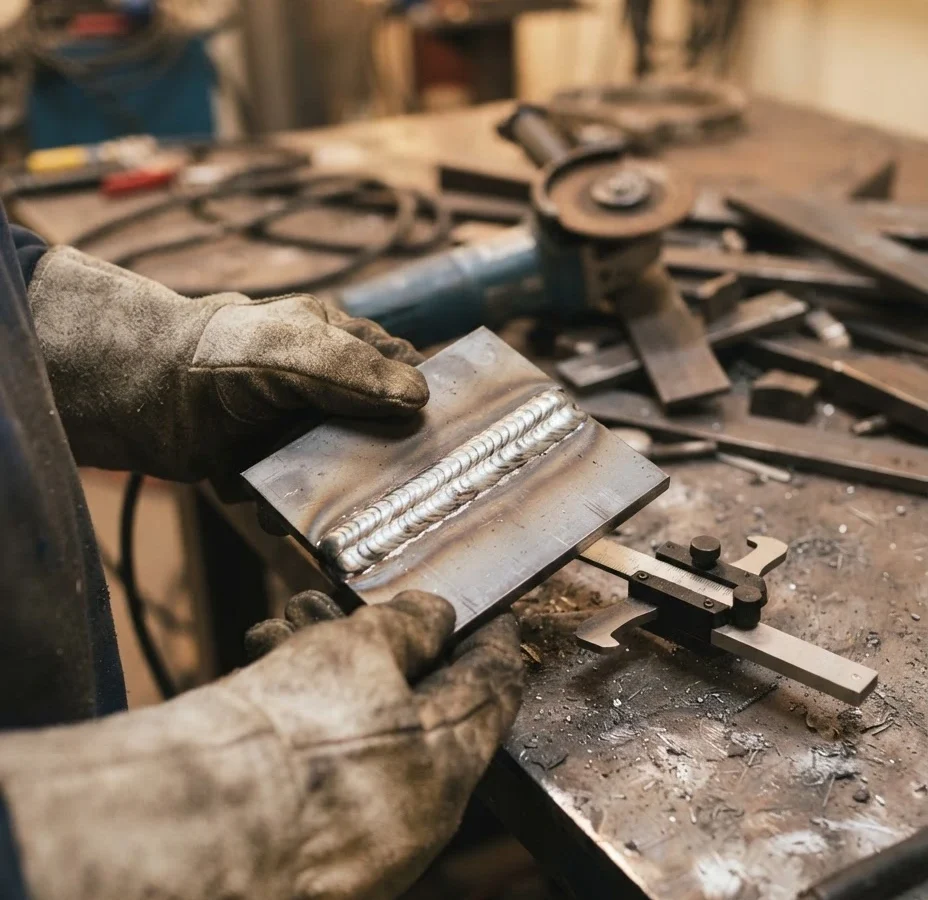
If you plan to weld in the GCC or Europe, expect a trade test before you start work. You weld a small test piece, called a coupon, in a set position and process, and an examiner checks it. For pipe welders, the test that matters most is 6G welding, on a pipe fixed at 45 degrees.
This guide explains in plain words what 1G to 6G mean, how SMAW and TIG are used on a pipe test, what ISO 9606-1 and ASME Section IX ask for, and how a coupon is checked. It ends with practical steps to prepare.
1G to 6G welding positions
In the AWS and ASME system, the number is the position and the letter is the type of weld. G means a groove weld and F means a fillet weld, so 1G to 6G are groove positions only. Fillet positions are 1F to 4F on plate and 5F on fixed pipe.
The same number can mean different things on plate and pipe:
- 1G: flat plate, or a horizontal pipe rotated as you weld
- 2G: horizontal weld on plate, or a pipe standing vertical
- 3G and 4G: vertical and overhead plate (plate only)
- 5G: horizontal pipe fixed in place (pipe only)
- 6G: pipe fixed at 45 degrees (pipe only)
So when you talk to a counsellor or employer, say whether your highest position is on plate or pipe.
ISO names in Europe
European certificates use ISO 6947 codes instead, such as PA (flat), PC (like 2G), PF (vertical up, like 3G up), PE (overhead, like 4G), PH (like 5G up) and H-L045 (like 6G up).
The 6G pipe test
In a 6G test the pipe is fixed at 45 degrees and cannot be turned, so you work your way round the joint. A harder variant, 6GR, adds a restriction ring or plate near the joint. Under ASME Section IX, passing a 6G pipe groove test qualifies a welder for all positions, groove and fillet, which is why it carries so much weight.
SMAW and TIG on one coupon
SMAW is stick welding, and TIG is also called GTAW. A common pipe test uses a TIG root pass with SMAW fill and cap. India’s own ITI Welder (Pipe) curriculum describes exactly this: a 6G root pass by GTAW, with intermediate and cover passes by SMAW. On ISO certificates, stick welding is process 111 and TIG is 141, so this combination shows as 141/111.
Welder qualification standards
Different employers test you to different rules. These are the three you are most likely to meet.
ISO 9606-1 in Europe
ISO 9606-1 is the international standard for qualifying welders on steel. The current edition is ISO 9606-1:2012, published in Europe as EN ISO 9606-1:2017, and ISO has marked it for revision, so check which version your employer uses.
You weld a test piece to a welding procedure specification (WPS), witnessed by an examiner or examining body. For pressure equipment in the EU, this is a notified body or recognised third party.
ASME Section IX in the GCC
Pipe work on GCC process plants is mainly qualified to ASME Section IX, while cross-country pipelines often use API 1104. Under ASME IX, qualifying a welder is the employer’s own responsibility. In practice, many GCC contractors test every new welder on arrival, to their own procedure.
Saudi SVP for welders
Welding is a trade under Saudi Arabia’s Skill Verification Program (SVP). Welders recruited from India take a short theory test and a practical test, usually on the same day, at test centres in India approved by NSDC and Takamol. The SVP is a general trade check, separate from any coupon test a Saudi contractor may still ask for. Rules change, so confirm the current steps with your registered recruiting agent, and see our Work in the GCC page.
How a test coupon is checked
Every coupon is checked by eye first. If it passes, it is tested further, often by cutting it into strips.
- Visual testing: always done, before any other test.
- Bend tests: under ASME IX, two face and two root bends, or four side bends. Open defects over 3 mm mean a fail.
- Radiography: an X-ray check, which ASME IX allows instead of bend tests.
- Fracture or macro tests: used under ISO 9606-1, mainly for fillet welds, with ultrasonic testing allowed in some cases.
Under ISO 9606-1 your test weld must include at least one stop and restart for each process, so practise them well.
How to prepare for the test
Start with an honest view of your level. The general ITI Welder course covers pipe only in 1G and TIG only in 1F and 1G, with no 5G or 6G, while ITI Welder (Pipe) includes both. If you have mostly welded plate, plan for more booth time before a 6G test.
- Note your highest position, plate or pipe, and the processes you use.
- Practise the exact test combination, such as a 6G TIG root with SMAW fill and cap.
- Practise clean stops and restarts in every pass.
- Learn to read a WPS and weld symbols to ISO 2553 and AWS A2.4.
- Inspect your own welds, then cut and bend mock coupons.
- Learn the ISO position names if you are aiming for Europe.
- Practise describing your welding work in simple English.
Once qualified, keep it valid. ASME IX qualifications last while you use the process at least once every 6 months, and ISO 9606-1 certificates need a 6-monthly confirmation too.
How AnywhereSkills can help
If you want a 6G welding course in India, our Pipe Welder Programme runs for 30 working days. It is for ITI welders or anyone with at least 1 year of welding work, and pipe experience helps most. You get booth practice every day on plate and pipe with SMAW and TIG, working up to 6G, plus classroom modules on theory and safety, codes and weld symbols, and English for interviews.
Mock coupon tests are checked by eye and cut for bend testing. You finish with an AnywhereSkills certificate of completion and a scorecard for every module. We do not issue ISO 9606-1, ASME or SVP results, which come from examining bodies, employers or the official SVP platform.
AnywhereSkills is not a recruiting agent. Selection, visas and deployment are handled only by recruiting agents registered with India’s Ministry of External Affairs. Jobs depend on employer demand and visa approval, and no job or visa is guaranteed. Our Work in Europe page explains why EU labour data lists welders among the most widespread shortages.
Common questions
Does 6G cover every position?
Under ASME Section IX, a 6G pipe groove test qualifies you for all positions, groove and fillet. Your certificate still lists the process and range it covers, so read it carefully.
Is my Indian certificate valid abroad?
Not always. An ASME IX qualification belongs to the employer and is generally not portable, so GCC contractors usually test you again.
How long does ISO 9606-1 last?
It must be confirmed every 6 months, or it lapses. It is then renewed by a retest every 3 years, or every 2 years using tested production welds, as printed on your certificate.
AnywhereSkills is a skilling company, not a recruiting agent. Jobs abroad depend on employer demand and visa approval, and no job, visa or work permit is guaranteed