Careers in the GCC
Crane operator certificate in the GCC: a guide for Indians
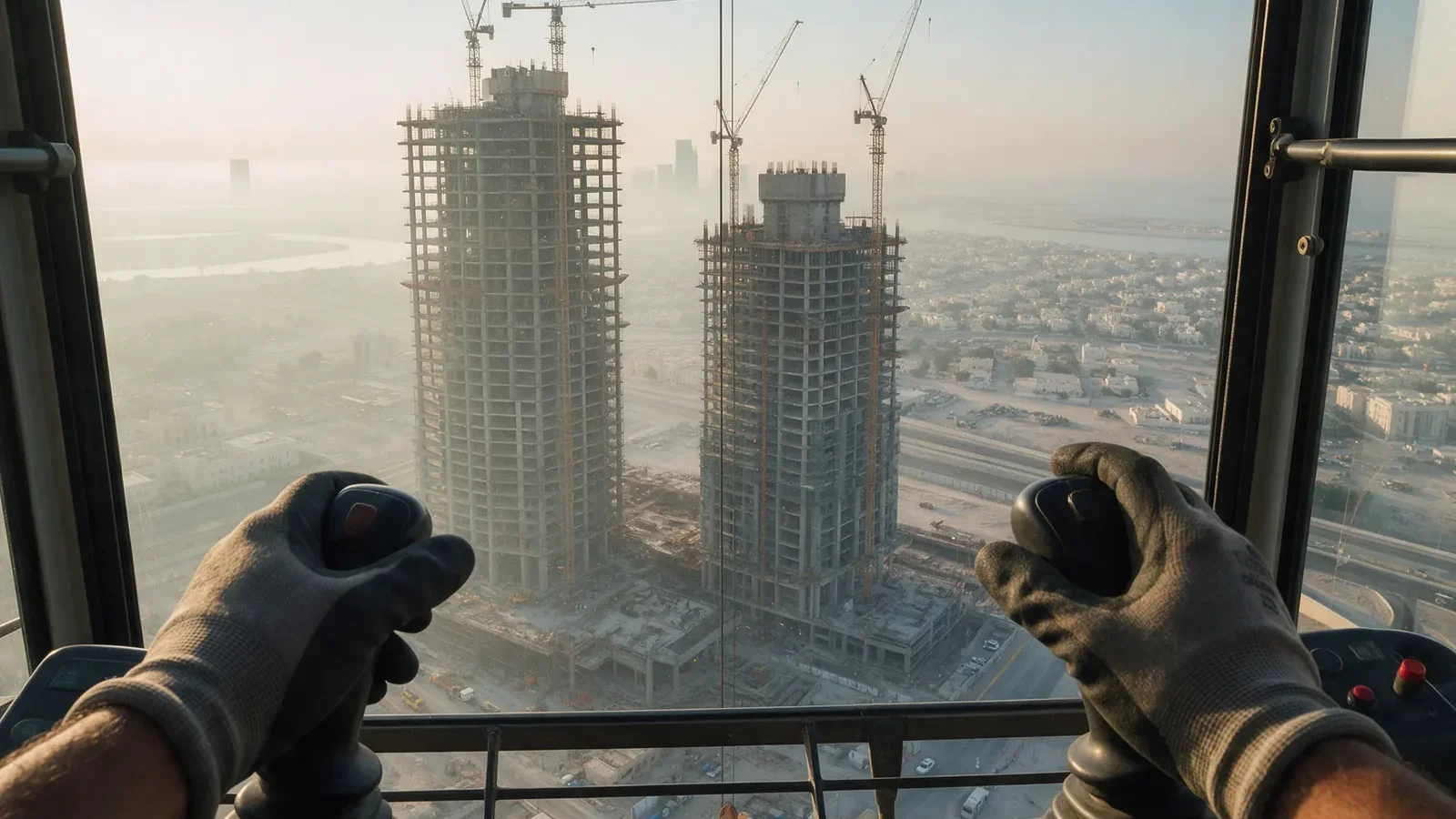
A crane operator certificate for the GCC is not one single document. Most Indian mobile crane operators need a third-party operator card (or, on Saudi Aramco sites, an Aramco certificate) plus a local driving or heavy equipment licence. Both are issued in the country where you work, and most are taken after you arrive.
The Saudi Skill Verification Program (SVP), which many workers hear about, does not list crane operation as a trade for India. Here is who issues what, the usual order of steps, and what to practise.
Who issues a crane operator certificate
In the GCC, the right to lift rests on separate documents from separate issuers. One large Saudi crane hire company says its operators hold three: a Saudi Aramco crane operator certificate, a third-party licence and a Saudi government licence. AnywhereSkills issues none of these.
Third-party operator cards
A third party crane operator certificate comes from a certification body such as TÜV Rheinland, Applus or TÜV SÜD, under ISO/IEC 17024. In Dubai, these schemes are accredited by EIAC and aligned with Dubai Municipality. Every scheme has a written paper and a practical test on the crane.
- TÜV Rheinland (Dubai): minimum age 18, at least 1 year of lifting experience, a written paper of at least 50 questions with an 80% pass mark, and a practical with a 75% pass mark. The certificate is valid for 1 year.
- Applus (UAE): minimum age 21, an 80% pass mark in the written paper, and a practical on the client’s crane with a 75% pass mark. The certificate is valid for 1 year.
- TÜV SÜD (Qatar): over 18, at least 3 years of experience, English good enough to work safely, and at least 3 days of course time before first certification. The written pass mark is 70% and the practical 75%, and the certificate is valid for 3 years.
If you are aiming for a crane operator job in Dubai, note that both Dubai schemes ask for a UAE residence visa and labour card, a local driving licence and an occupational health card. In Abu Dhabi, the ADOSH-SF lifting code says operators need the right UAE licences and approval from an approved third-party provider. Riggers (slingers) and signallers need the same third-party approval.
Saudi Aramco sites
If your crane operator job in Saudi Arabia is on a Saudi Aramco onshore site, the operator certificate is issued by Aramco itself, for that specific equipment. Under Aramco’s General Instruction 7.025, you also need a valid Saudi government driving or heavy equipment operator licence with the equipment stamp, and a medical form.
Aramco written tests are in English only, and the certificate is valid for 3 years. The copy of GI 7.025 we checked is the 2011 revision, so ask your employer for the current rules.
Local driving or equipment licence
The licence is separate from the card and comes from a government body where you work. The Dubai and Qatar card schemes ask for a local driving licence before you can sit the card test.
Saudi Arabia now also licenses heavy equipment operators through the SASO Heavy Equipment Regulatory Center. Rules published in March 2024 set an age range of 18 to 60, medical fitness, completion of an approved course, and a licence valid for 3 years. Ask your employer which Saudi licence your site needs.
Where Saudi SVP fits in
The Saudi Skill Verification Program, also called Professional Verification, is run by Saudi Arabia’s Ministry of Human Resources and Social Development. It tests workers in listed trades with a theory and a practical test. In India it runs through NSDC and Takamol at approved test centres, before the Saudi work visa.
SVP for India covers trades such as welder, plumber, electrician, auto electrician and HVAC technician. Crane operator is not on any published SVP list for India, so SVP is not part of the usual crane route. Trade lists can change, so confirm with your recruiting agent before you apply.
Order of steps from India
- Prepare in India: brush up your crane skills and English, and keep proof of your experience ready, as card schemes ask for 1 to 3 years.
- Interview and selection: a recruiting agent registered with India’s Ministry of External Affairs handles selection, the offer and the visa. Check the agent’s registration number in the list of active recruiting agents on emigrate.gov.in.
- Visa and clearance: the employment visa comes next. Emigration clearance on eMigrate is needed only if your passport is ECR, and if you passed 10th your passport is usually ECNR. ECR workers also need the compulsory Pravasi Bharatiya Bima Yojana insurance policy.
- Before you fly: the government runs a one-day Pre-Departure Orientation on your destination, your rights and the emigration process.
- Arrival: you get your residence visa and, in the UAE, the labour card and occupational health card that card schemes ask for.
- Local licence: you get the local driving or heavy equipment licence your site needs.
- Operator card: you then sit the third-party card test, or the Aramco test on Aramco sites. When the card expires after 1 to 3 years, you test again.
The order differs by country, site and employer, and rules change often, so check the current position with your recruiting agent and the official sources.
What to prepare for the test
Card tests check the same core skills across the GCC, based on standards such as ASME B30.5, BS 7121-3 and ISO 12480-1. Most tests are in English, so practise the technical words too.
- Load charts: capacity against radius, boom length and boom angle, and keeping every lift inside the chart.
- Safety systems: how the LMI, RCI or rated capacity limiter (RCL) on the crane works.
- Set-up: outriggers, ground conditions and ground bearing.
- Rigging: inspecting slings, shackles and hooks, sling angles and their effect on capacity, and estimating load weight and centre of gravity.
- Signalling: standard hand signals (ISO 16715 is the international standard), radio calls and working with one signaller.
- Site safety: lift plans, exclusion zones, power line clearance and wind limits. In Abu Dhabi, lifting must stop when wind reaches or gusts above 38 km/h, and each site sets its own power line distances.
- Fitness: eyesight, colour vision and hearing, which some schemes check.
Written pass marks in these schemes run from 70 to 80%, and the practical pass mark is usually 75%.
How AnywhereSkills can help
The Mobile Crane Operator Programme runs for 15 working days and is for operators with at least 2 years of mobile crane experience in India. It covers Crane Theory and Safety, Rigging and Signalling, English for Interview Preparation, and daily Crane Practical sessions that include a mock third-party practical test.
You finish with an AnywhereSkills certificate of completion and a scorecard for every module. AnywhereSkills is a skilling company, not a recruiting agent, and does not issue any operator card, licence, visa or emigration clearance.
If you choose job support, selection, visas and deployment are handled only by recruiting agents registered with India’s Ministry of External Affairs. Jobs depend on employer demand and visa approval, and no job or visa is guaranteed. For the wider route, see Work in the GCC.
Common questions
Is the operator card included?
No. The card is issued in the GCC by an approved third-party body, or by a site owner such as Saudi Aramco, usually after you arrive. The programme prepares you for its test.
Do crane operators need SVP?
Usually not. Crane operation is not on any published SVP list for India, but lists can change, so confirm with your recruiting agent.
How long is a card valid?
Dubai scheme cards are valid for 1 year, while TÜV SÜD Qatar cards and Saudi Aramco certificates last 3 years. After that, you test again.
AnywhereSkills is a skilling company, not a recruiting agent. Jobs abroad depend on employer demand and visa approval, and no job, visa or work permit is guaranteed